
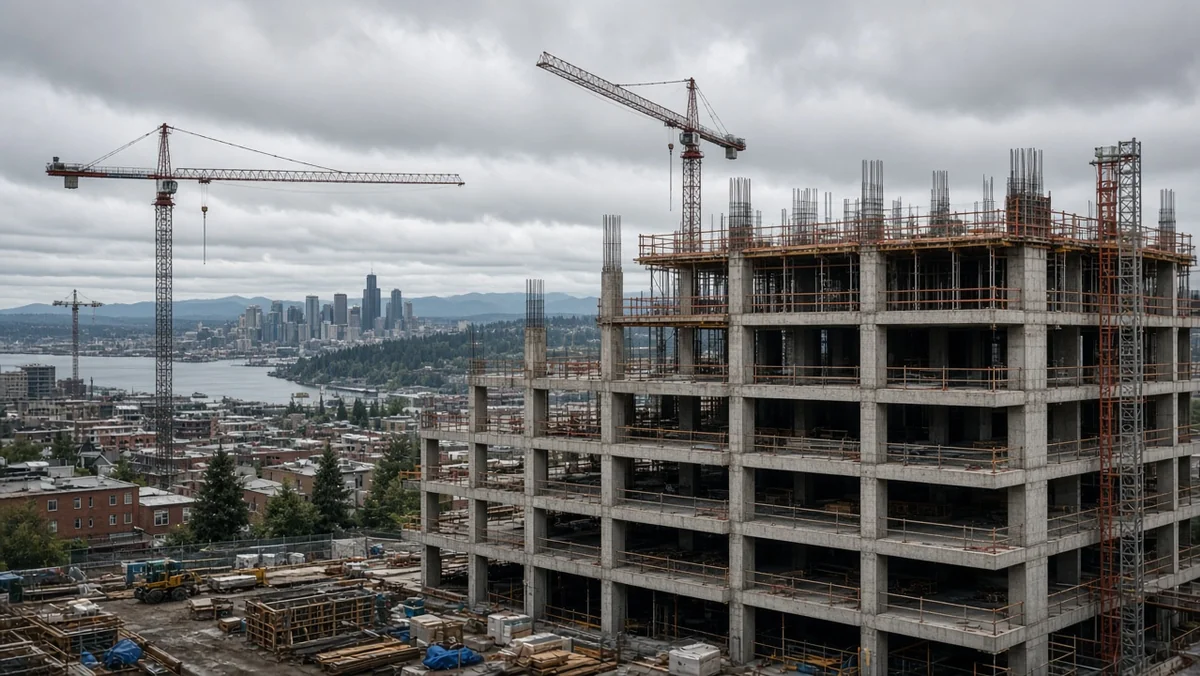
SEATTLE — City Councilmember Dionne Foster has introduced legislation that would temporarily slash Seattle’s Mandatory Housing Affordability fees for stalled pipeline projects, reviving a developer-backed break that collapsed earlier this year amid a fight over housing production versus affordable-housing funding.
PubliCola’s Erica C. Barnett reported the deal on Sept. 16, 2026. Under Foster’s bill, developers with roughly 30 projects already in the city’s pipeline would receive an 80 percent reduction in Seattle MHA fees for the next two years—if they reach the foundation-inspection stage within two years, a pace rule meant to keep fee breaks from sitting idle.
What the fee holiday would and would not cover
According to PubliCola, the legislation also opens a narrower path for new, non-vested projects in 2027 only. Those projects would get a 60 percent MHA cut if at least 25 percent of units are two bedrooms or larger and the project reaches foundation inspection within three years after building permits. Legacy homeowners developing their own property would get the deeper 80 percent reduction, PubliCola reported.
In a concession to affordable-housing advocates who argued a blanket “holiday” would drain funding, the bill exempts the Central District, the Chinatown-International District, and much of Southeast Seattle. PubliCola noted that two of the roughly 30 stalled projects sit in the exempt geography but are on vacant land. No developer could propose a new project in those exempted areas while the lower fees are in place, under the deal as described.
MHA fees, which help fund affordable housing, have already fallen sharply as construction slowed—from about $74 million in 2021 to about $22 million last year, PubliCola reported.
Foster’s case—and the mayor’s parallel track
“This feels really important because we have a lot of projects that are stalled and permits that are trending down, and this is an opportunity to take action,” Foster said, according to PubliCola. She also highlighted the two-bedroom rule as a way to push more family-sized units into a market short on them.
Mayor Katie Wilson’s office was not part of Foster’s deal. PubliCola reported that Wilson had been working on a parallel track—earlier involving Councilmember Eddie Lin—and announced a Housing Production Task Force after a similar agreement fell apart when affordable-housing developers withdrew support. Developers have argued that a drawn-out task-force timeline would kill projects already in the pipeline.
In a statement to PubliCola, Wilson said her task force will “work on multiple fronts to accelerate the production of housing and prevent displacement, including short and long-term updates to MHA,” while respecting Foster’s choice to move a temporary holiday now. Foster called the mayor’s parallel work “critical.” Her package also includes a resolution saying the council “intends to consider and act on legislation” applying MHA to neighborhood residential areas now open to small apartments but currently exempt from MHA, PubliCola reported.
How Seattle’s housing fight fits a wider map
Cities elsewhere are pairing housing fights with transit and zoning debates—whether Seattle’s Hop On Board transit measure, Salt Lake City’s expanding housing options, Jacksonville’s affordable housing trust fund budget choices, or Southern California fights over SANDAG and SB 79. Foster’s Seattle MHA fees proposal is narrower: a temporary fee schedule aimed at unsticking vested permits while protecting some high-displacement neighborhoods from a fee holiday.
Why this matters
Seattle MHA fees fund affordable housing while also shaping whether market-rate projects pencil out. An 80 percent two-year break for about 30 stalled projects could restart construction—or reduce dollars for subsidized units as fee collections already fell from peak years. Exemptions for the Central District, Chinatown-International District, and much of Southeast Seattle are the political hinge. Residents should watch the council deliberation and Wilson’s task force.
How Never Late News reported this
Never Late News summarized PubliCola’s Sept. 16, 2026, report by Erica C. Barnett on Councilmember Dionne Foster’s Mandatory Housing Affordability fee legislation, including the roughly 30 stalled pipeline projects, the proposed 80 percent two-year fee reduction with a two-year foundation-inspection deadline, the 2027 new-project path with a 60 percent cut and 25 percent two-bedroom rule, geographic exemptions, the fee-collection drop from about $74 million in 2021 to about $22 million last year, Foster’s quotes, Mayor Katie Wilson’s task-force statement, and the neighborhood-residential MHA resolution language as published by PubliCola. We did not invent a final council vote date, project-by-project addresses, or guaranteed unit counts. Readers should verify bill text and hearing schedules on official Seattle City Council channels as the legislation moves.
Corrections and reader feedback
If you spot an error in this report, email tips@neverlatenews.com. We correct the record promptly and note substantive updates at the bottom of the story when needed.
1 thought on “Seattle Councilmember Foster Revives Temporary MHA Fee Holiday for Stalled Housing Projects”
Comments are closed.