
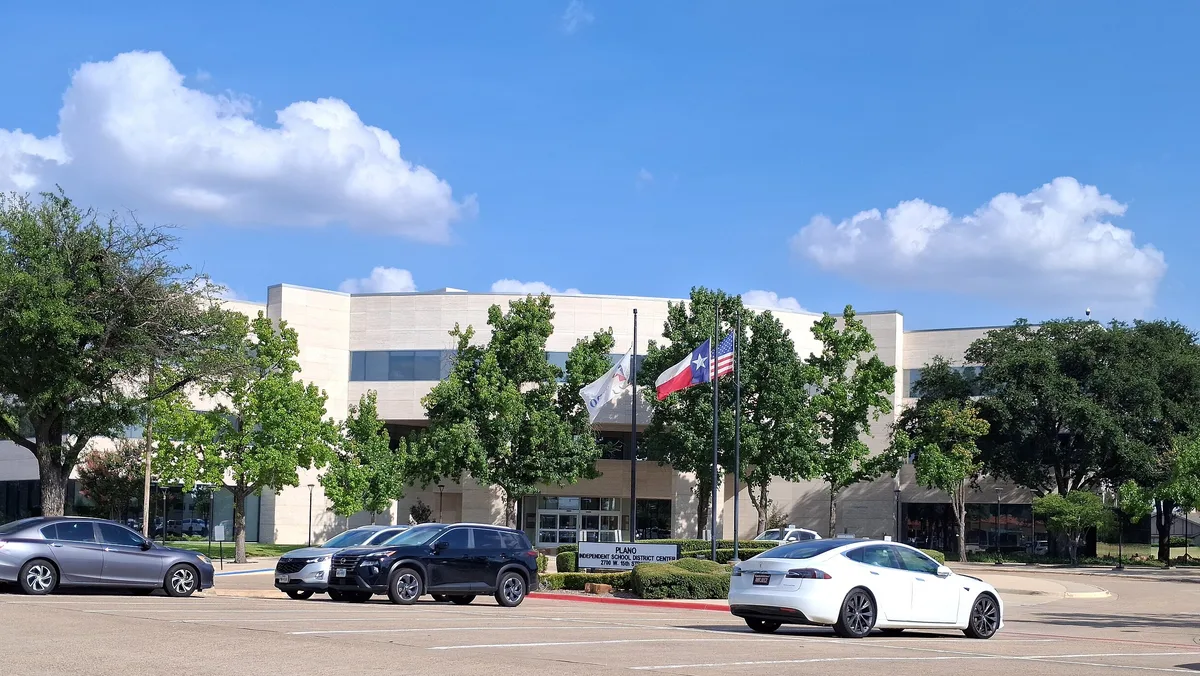
Plano ISD legislative priorities for the next Texas Legislature are now posted on the district’s website, and the first funding request is specific: raise the state’s school safety, special education, transportation and ABC allotments and tie them to inflation. The district’s own adopted budget for 2026-27 shows why that request carries weight. Plano ISD expects $67 million in state program revenue in its general operating fund this year, while it budgets $132.5 million for the intergovernmental charges line that Texas districts use for recapture payments.
That gap, nearly two to one, sits under almost every item on the list.
The priorities are written for the 90th Legislature, which convenes in January. They are grouped under four headings: school funding, accountability, the educator workforce, and student safety, mental health and digital responsibility. Here is what each asks for, and what the district’s 2026-27 legally adopted budget says about the money behind it.
What the Plano ISD legislative priorities ask for
The district opens with a statement of principle. “We believe that any school receiving public funds should meet the same standards for student safety, academic results and financial accountability,” the priorities page says. The same idea comes back under accountability as a request to “hold all public funding recipients to the same standard.”
That language lands as Texas families sign up for the new Texas Education Freedom Accounts, the state’s education savings account program. Never Late News has tracked how many TEFA students are enrolled by North Texas district. Plano ISD’s page does not name the program, but the standard it describes would apply to any school taking public money.
Under funding, the district asks lawmakers to:
- Increase the School Safety, special education, Transportation and ABC allotments and index them to inflation
- Report recapture collections clearly and reinvest money collected above the entitlement back into public schools
- Fund excused absences at 100%
- Provide funding stability for districts with declining enrollment, recognizing fixed operating costs
- Commission a review of past legislative requirements to sunset obsolete or duplicative mandates
Under the workforce heading, it asks for funding that accounts for high-cost labor markets, more certification pathways and mentoring, better access to affordable health care and benefits, and full funding of the Teacher Retirement System with inflation-responsive adjustments.
The last heading covers responsible use of AI with clear state guidance and data protections, social media’s effect on students, more cybersecurity help for districts through Texas Cyber Command, and a dedicated student mental health allotment kept separate from safety and security money.
The recapture line next to state aid
Recapture is the part of Texas school finance that sends local property tax collections from districts with high property wealth to the state. In Plano ISD’s adopted general operating budget, function 91, intergovernmental charges, is budgeted at $132,542,743.
State program revenue in the same fund is $66,996,844. Never Late News divided the first figure by the second: the recapture line is about 1.98 times what the state sends Plano ISD’s operating fund. Put another way, the district’s recapture budget is $65.5 million larger than its state revenue.
The budget also shows how much of the operating fund comes from local taxpayers. Local revenue is $563,628,784 of $634,640,628 in total revenue, or 88.8%. State revenue is 10.6%, and federal revenue, $4,015,000, is under 1%.
On the spending side, total general operating expenditures are $691,640,628. The recapture line is about 19% of that, which means roughly 19 cents of each operating dollar the district budgets leaves the district.
That is the context for the request to “report recapture collections clearly.” The district is asking the state to show taxpayers where that money goes, and to return any amount collected above what districts are entitled to.
The shortfall the requests are meant to close
The adopted budget is not balanced. Expenditures exceed revenue by $57 million. After $15 million in transfers in and $2.8 million in transfers out, the general operating fund shows a net operating result of negative $44,800,000.
Never Late News first reported that figure when Plano ISD adopted its $1.03275 tax rate beside the shortfall. By our calculation, $44.8 million equals about 6.5% of the district’s operating spending this year.
The request for “funding stability mechanisms for districts experiencing enrollment decline” fits the same picture. Texas funds schools largely by student attendance, so when enrollment falls, state funding falls with it, while buildings, buses and many staff costs stay. The priorities page says so directly, asking lawmakers to recognize “fixed operational costs.”
What the allotment asks are tied to
The allotments named in the first funding request map to specific lines in the adopted budget:
- Transportation: $20,611,069
- Security services: $10,088,276
- Health services: $7,525,758
- Guidance and counseling: $27,191,072
Security and transportation alone come to about $30.7 million. Those are costs the district pays mostly from local revenue unless state allotments grow. The ask to index allotments to inflation is about the gap between what those services cost each year and what the state formula pays.
The mental health request is related. Plano ISD wants a dedicated student mental health allotment “separate from safety and security,” so counseling and support services do not compete with campus security for the same state dollars. At $27.2 million, guidance and counseling already costs more than transportation in this budget.
Why it matters beyond Plano
Plano ISD’s list is one district’s position, but the money questions are regional. Collin County voters are weighing other education debt this fall, including the Collin College bond on the Nov. 3 ballot, and any change lawmakers make to recapture or allotments would reach every Texas district, not just Plano.
The priorities do not carry the force of law. They tell lawmakers, and residents, what the district will lobby for when the session opens. Families who want to weigh in can read the full list on the district’s legislative affairs page and compare it with the budget figures above.
How Never Late News reported this
This report is based on these public records:
- Plano ISD legislative priorities, 90th Session, the district’s posted list of four priority areas and their specific requests
- Plano ISD 2026-27 legally adopted funds, the adopted general operating, debt service and food service budgets by revenue source and function
The recapture-to-state-revenue ratio (1.98 times), the $65.5 million difference, the local, state and federal revenue shares, the 19% recapture share of spending, the 6.5% shortfall share and the $30.7 million security and transportation total are Never Late News calculations from those records. No interviews were conducted for this report. To report an error, email editor@neverlatenews.com.