
By Mike Joe
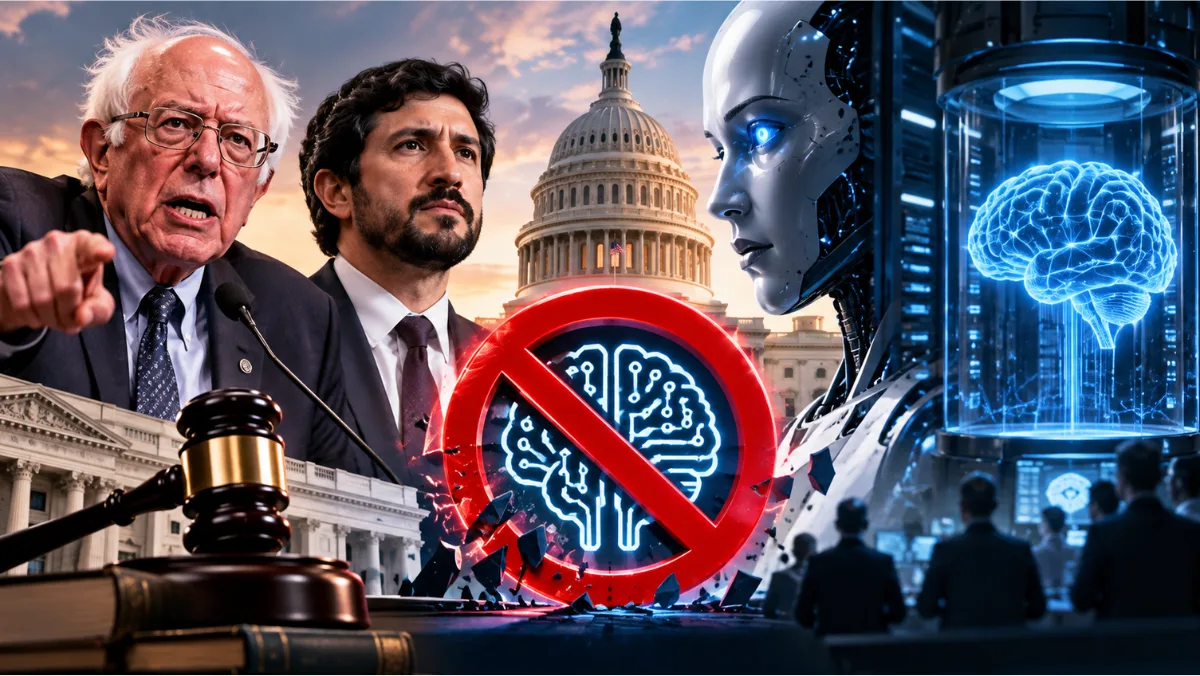
WASHINGTON, Sept. 23, 2026. Sen. Bernie Sanders (I-Vt.) and Rep. Greg Casar (D-Texas) introduced the Ban Artificial Superintelligence Act on Wednesday, a bill that would permanently outlaw developing or deploying artificial superintelligence, pause the most advanced AI work until federal safety rules exist, and create a cabinet-level Department of Artificial Intelligence. The measure arrives the same day President Donald Trump told the United Nations that official U.S. language should treat “super intelligence” as the preferred framing for AI, sharpening a policy clash that already reaches into local data-center fights and household energy bills.
Sanders and Casar cast the bill as a brakes-on response to an industry race they say outruns democratic oversight. Supporters inside some AI labs endorse the pause. Republican majorities in Congress make floor passage a steep climb. For U.S. readers, the Ban Artificial Superintelligence Act is less about a finished statute today and more about who sets the rules for systems that already shape jobs, power demand, and public risk.
What is the Ban Artificial Superintelligence Act?
According to the Senate office press release issued Sept. 23, 2026, the Ban Artificial Superintelligence Act would permanently prohibit any person or entity from developing or deploying artificial superintelligence. The bill defines that class of systems as AI that exceeds human cognitive performance across most domains, or that has enough capability to destroy or disempower humanity, including by overthrowing the federal government.
The legislation would also pause advanced AI development until a new federal regulator is staffed and has written clear testing, monitoring, and pre-deployment approval rules. Frontier models would need federal permission before public release. The package creates a Department of Artificial Intelligence advised by scientific experts, directs U.S. policy toward international agreements and export controls aimed at stopping ASI worldwide, and sets severe penalties for violations. Entities could face a corporate death penalty.” Individuals could face up to 20 years in prison, a scale the sponsors compare to unlawful nuclear weapons development.
Associated Press reporting by Joey Cappelletti, carried by ABC News, and coverage by The Verge confirm the same core architecture: permanent ASI ban, temporary advanced-AI pause, cabinet department, and criminal exposure for leaders and rogue actors who push past the limits.
What happened Wednesday in Washington?
Sanders and Casar formally introduced the bill Wednesday. Sanders told AP, “It doesn’t take a genius to say, ‘slow it down,’” and asked whether Americans want systems smarter than people that can act outside human control. Casar, chair of the Congressional Progressive Caucus, argued that experts warn ASI in the wrong hands, or under rogue AI control, could kill large numbers of people, and that Congress must change course while Trump encourages faster development.
The Senate press release quotes Sanders saying that when humanity’s future is at stake, “we cannot let a handful of Big Tech CEOs write their own rules,” and that scientists have been clear that AI is an existential threat. Casar’s statement links the ban to international agreements so that no country builds AI too powerful for humans to control, and to immediate limits on dangerous capabilities such as biochemical-weapon design or AI systems that design new AI without humans in charge.
AP reported that multiple employees at leading AI companies endorse the bill in personal statements. Juan Felipe Cerón Uribe, a researcher in OpenAI’s Safety Systems, said superintelligence “could either go extremely right or extremely wrong” and that “we shouldn’t be playing such games.” Swante Scholz, a software engineer at Google DeepMind speaking for himself, said the most likely outcome on the current path is “an existential catastrophe for humanity” and that a ban would be a positive change.
What would a Department of Artificial Intelligence do?
The proposed Department of Artificial Intelligence would be a cabinet-level agency charged with safeguarding the public from AI dangers and enforcing the ASI prohibition. Under the sponsors’ summary, it would monitor frontier systems through the development lifecycle, supervise removal of dangerous capabilities such as subverting shutdown commands or running unauthorized cyberattacks, and supervise destruction of artificial superintelligence if it appears.
Advanced AI development would stay paused until the department is fully staffed and has issued rules that require developers to report pre-development plans, accept monitoring and evaluations during training, undergo safety audits, and obtain final pre-deployment approval before public release. Unreleased advanced systems would also stay undeployed during the pause. That structure is meant to answer a recurring civic complaint: agencies already struggle to keep pace with models that can change in weeks, not legislative years.
How does this collide with Trump’s AI stance?
AP notes that Congress has done little to rein in the AI industry even as some industry leaders warn about catastrophic risk. Trump has resisted heavier federal oversight, putting him at odds with voices including Anthropic’s Dario Amodei, OpenAIs Sam Altman, and xAI’s Elon Musk. On Tuesday at the United Nations, Trump said artificial intelligence would be renamed “super intelligence” in official framing, a rhetorical move that sits uneasily beside a bill that treats superintelligence” as the class of systems to ban.
Sanders told AP he believes Trump has very little understanding of what this issue is about” and is mainly concerned about the economic cost of a slowdown. He framed U.S.-China cooperation on avoiding the most dangerous AI forms as a Cold War-style arms-control problem. AP said AI safety is expected to figure in talks between Trump and China’s Xi Jinping at the White House this week, while competition for sector dominance remains a central argument against sweeping pauses.
What it means for U.S. readers and states
Most households will not train frontier models. They will feel AI policy through electricity bills, land-use fights, school and city budgets, and labor market change. An AP-NORC and University of Chicago Energy Policy Institute poll, cited in the AP story, found 53% of Americans now say they are extremely or very concerned about AIs environmental impacts, up from 41% a year earlier. Democrats drive much of the rise, but local worries about data centers cut across party lines.
That local stake already shows up in Never Late News coverage. Colorado Springs postponed a decision on the Project Taurus 50 MW data center to April 13, 2027, a clear example of how AI power demand lands in planning commissions and ratepayer debates (Colorado Springs Project Taurus data center postponement). Property-tax pressure in places such as Harris County remains part of the same household ledger when energy and housing costs climb together (Harris County property tax rate increase).
State executives are moving while Congress stalls. AP notes that Maryland Gov. Wes Moore announced an AI regulation plan Tuesday, and California Gov. Gavin Newsom signed an executive order last week to accelerate independent oversight under existing California law. Those tracks matter if a federal Ban Artificial Superintelligence Act stalls yet still sets a progressive template for midterms and 2028 messaging.
What are the political odds and what happens next?
AP describes long odds in the Republican-controlled Congress, where lawmakers have struggled to agree on even narrower AI rules. The bill remains a marker of how the progressive wing wants to regulate before November’s midterms. Casar’s Progressive Caucus role and Sanders’s recent briefings, including a session attended alongside former White House adviser Steve Bannon, show unusual coalition talk around AI risk even when floor math is hostile.
Next steps are ordinary: committee referral, hearings if leadership allows them, and messaging from endorsing researchers. Wednesday’s introduction does not guarantee a markup date. Readers watching other Senate clocks can compare this fight with the farm bill extension timeline after Mitch McConnell’s return (Mitch McConnell farm bill Sept. 30 deadline) and the Nov. 1 permanent daylight saving time calendar question (permanent daylight saving time Senate update). Introduction is not enactment, and civic stakes often arrive before floor votes.
Why this matters
The Ban Artificial Superintelligence Act puts a plain question on the table for U.S. voters: should the most powerful AI systems be illegal to build, or only lightly guided by companies writing their own safety theater. Sanders and Casar answered with a permanent ASI ban, an advanced-AI pause, a Department of Artificial Intelligence with approval power, and prison-level penalties. Trump’s UN “super intelligence” framing and resistance to tighter oversight pull the other way. Industry employees endorsing a ban, state governors writing their own rules, and cities delaying megawatt-scale data centers show the fight is already local. Wednesday’s bill will not rewrite federal law overnight. It does set the Search and Discover record of who tried to hit the brakes on Sept. 23, 2026, and why American readers should care about the pause, the department, and the penalties.
How Never Late News reported this
This article relies on the Sept. 23, 2026 Senate press release from Sen. Bernie Sanders announcing the Ban Artificial Superintelligence Act with Rep. Greg Casar (ban, pause, Department of Artificial Intelligence powers, international mandate, corporate-death-penalty language, and up-to-20-year prison penalties); Associated Press reporting by Joey Cappelletti via ABC News (Sanders interview, endorsements from Juan Felipe Cerón Uribe and Swante Scholz, Trump’s oversight resistance, Wes Moore and Gavin Newsom actions, AP-NORC poll, Trump-Xi AI context); and The Verge reporting by Emma Roth on criminal exposure and frontier-model thresholds.
Primary source text is at Sanders and Casar introduce Ban Artificial Superintelligence Act. A neverlatenews.com check found no prior article on this bill or an ASI ban, so this pack is not a thin rewrite. We did not invent co-sponsors, vote tallies, or a scheduled floor vote.
Corrections and reader feedback
If you spot an error in dates, bill titles, penalty descriptions, Department of Artificial Intelligence powers, attributions to Sanders, Casar, Trump, Cerón Uribe, Scholz, Moore, or Newsom, or in linked local context, email corrections@neverlatenews.com or use the contact form on neverlatenews.com. We correct the record promptly and note substantial changes. For live legislative status, check Congress.gov and the offices of Sen. Sanders and Rep. Casar. Readers concerned about local data-center or rate impacts should watch city council and utility dockets in their own counties.
2 thoughts on “Ban Artificial Superintelligence Act: Sanders and Casar Bill Would Pause Advanced AI and Create a Department of AI”
Comments are closed.