
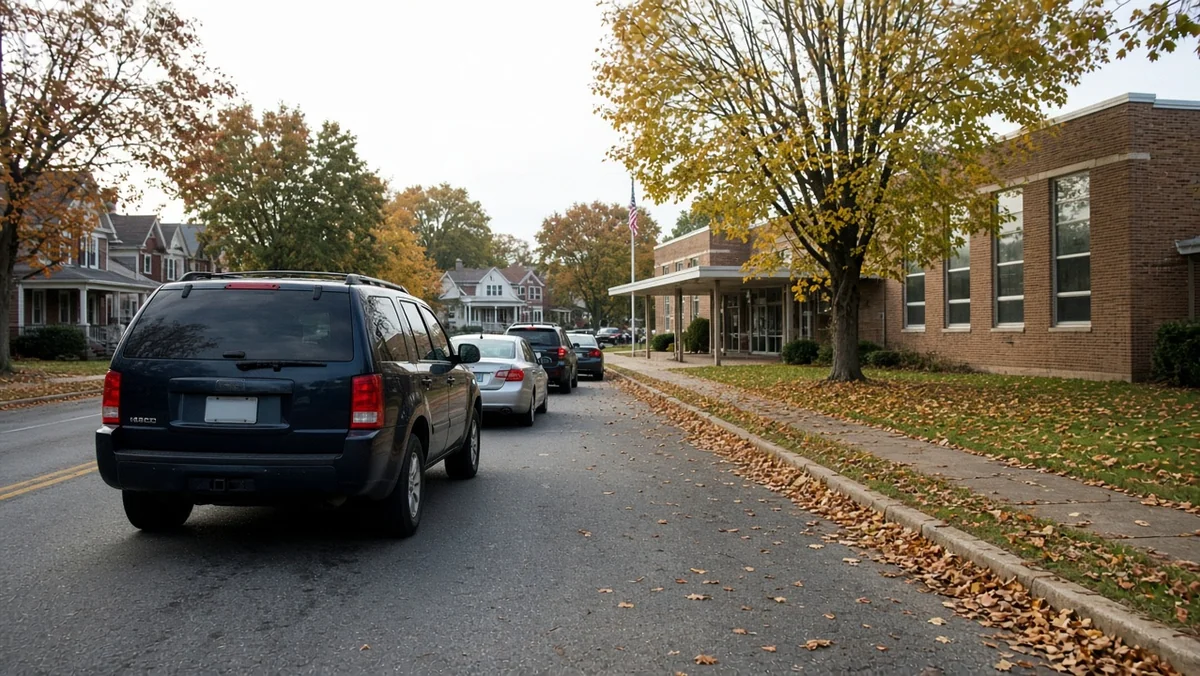
Amherst schools busing remains a central issue in this local transportation debate.
Amherst schools families are watching the Nov. 3 vote.
Amherst schools and the levy
Amherst schools officials say the levy could help restore some transportation service.
AMHERST, Ohio — Amherst Exempted Village Schools has eliminated regular busing for grades 9–12, tightened eligibility for K-8 riders, and cut driver positions—changes that lengthened car lines at Powers Elementary—while a 5.97-mill fixed-rate property tax levy seeking about $5.8 million a
year heads to the Nov. 3, 2026, ballot.
Hoodline’s September 2026 reporting, paired with district financial materials, frames the transportation cuts as part of a state-required financial reduction plan totaling roughly $13.2 million in cuts across fiscal years 2026 through 2029. Voters already rejected income-tax levy attempts in November 2025 and May 2026. District leaders have discussed restoring some transportation if the November property-tax levy passes.
What changed for students and parents
High school students who once counted on a yellow bus now need another ride. Younger students face tighter distance rules, which pushes more families into morning drop-off lines. Powers Elementary’s car queue has become the visible symbol of the policy shift: working parents circling blocks, late bells, and traffic friction on streets that were not designed as permanent pickup lots.
Cutting driver positions makes restoration harder even if money returns. A levy win does not instantly recreate a route network; the district would still need licensed drivers, viable stops, and a phased plan. Families should ask for that phase plan in writing before treating Nov. 3 as an on/off switch for every lost seat.
The levy math and the rejection history
District materials describe a 5.97-mill fixed-rate property tax expected to generate about $5.8 million per year. That ask arrives after two failed income-tax levies in November 2025 and May 2026, so campaigners on both sides will argue credibility as much as millage. Supporters cast the levy as the difference between deeper program cuts and partial restoration of services such as transportation. Opponents will point to the same rejection history and ask why a property-tax structure should succeed where income-tax asks failed.
Household budgets are already strained by national cost-of-living debates, including Social Security COLA estimates and political talk of dividend checks. Local school taxes land in that same wallet. Ohio roadway riskillustrated recently when an Ohio State Highway Patrol trooper was struck while managing flood traffic—also keeps safety in the foreground when more teens drive or walk routes that used to be bused.
How this fits a louder civic fall
Federal oversight headlines such as the Kash Patel FBI Senate hearing will dominate national feeds into midterms, but Amherst’s Nov. 3 levy is the ballot line that decides whether this district can reverse parts of a $13.2 million reduction plan. Parents comparing carpool spreadsheets to millage tables are doing the same civic work as voters reading Washington testimonythey are asking who pays and what service returns.
Why this matters
Ending regular 9–12 busing and tightening K-8 eligibility shifts cost and time onto families already navigating work schedules and Powers Elementary car lines. A 5.97-mill levy seeking about $5.8 million a year is the district’s stated path to stabilize finances after two failed income-tax attempts and a required multi-year cut plan. Whether transportation partially returns depends on both the Nov. 3 result and the district’s ability to hire drivers—not on election-night speeches alone.
How Never Late News reported this
Never Late News summarized Hoodline’s September 2026 reporting on Amherst Exempted Village Schools’ transportation cuts and levy timeline,
cross-checked against district financial-outlook materials describing a state-required reduction plan of roughly $13.2 million for FY2026–2029, elimination of regular grades 9–12 busing, tightened K-8 eligibility, driver-position cuts, Powers Elementary car-line impacts, prior income-tax levy failures in Novembr 2025 and May 2026, and the 5.97-mill fixed-rate property tax on the Nov. 3, 2026, ballot expected to raise about $5.8 million a year, with discussion of restoring some transportation if the levy passes. We did not invent passage odds, exact restored route lists, or tax bills for individual parcels beyond the district’s published millage framing. Voters should read the official ballot language and district outlook pages before Election Day.
Corrections and reader feedback
If you spot an error in this report, email tips@neverlatenews.com. We correct the record promptly and note substantive updates at the bottom of the story when needed.