
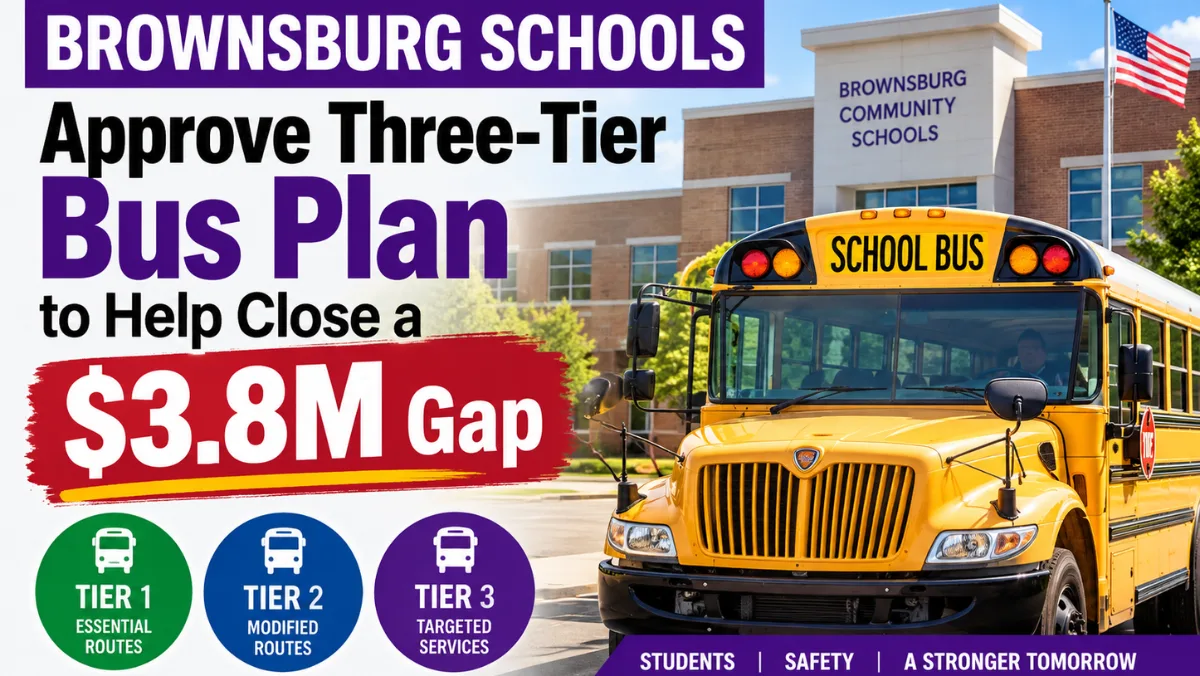
Brownsburg three-tier bus: BROWNSBURG, Ind. Brownsburg Community School Corp. buses will shift to a three-tier schedule in the 2027-28 school year after the school board unanimously approved a transportation overhaul meant to carve about $2 million out of a $3.8 million cut target for that year.
Current Publishing reported Sunday, Sept. 20, 2026, that the Sept. 14 vote also expanded parent responsibility zones, the walking distances inside which the district does not provide a bus. Together, the two changes are expected to deliver more than half of the 2027-28 savings the district says state legislation, including Senate Enrolled Act 1, is forcing into a larger three-year, $7.9 million reduction plan.
How the Brownsburg three-tier bus plan would work
Assistant Superintendent for Operations Shane Hacker told the board the district now runs a modified two-tier system. Under three-tier routing, a single driver would typically cover one elementary, one middle, and one high school route each morning and afternoon, cutting the total number of routes and drivers needed districtwide.
Hacker said the shift would require at least 60 minutes, and in some cases up to 80 minutes, between start times at each school level so a driver can finish a route, return, and start the next one. He said the high school route generally cannot run first because of a scheduling partnership with Area 31 at Ben Davis High School, meaning high schools would fall in the second or third tier at most stops.
Fewer routes also mean fewer buses in operation and lower fuel and maintenance costs, Hacker said. He told the board the district expects to reduce transportation staffing largely through attrition rather than layoffs, citing high annual turnover among bus drivers and a broader driver shortage.
Walk zones get wider
The same night, the board approved increasing parent responsibility zones from a half-mile to a mile for elementary students and to a mile and a half for secondary students. That change alone is projected to save about $720,000, Current Publishing reported.
District officials estimate the combined transportation package will eliminate dozens of bus stops and hundreds of riders across elementary and secondary schools. Hacker described the walk-zone changes as easier to reverse than three-tier routing if the state later restores funding. “The tier three would be a little more difficult, probably, to come back and undo once we get down this path,” he said, according to Current Publishing.
What is not locked yet
The September vote does not freeze a final bell schedule. Staff will spend the coming months working with transportation officials, athletics, performing arts programs, and other groups on specific start times before presenting a complete plan to the board in December. The district plans informational meetings for families Oct. 27-29.
That sequencing matters for parents who need to rearrange work, child care, and after-school activities. Three-tier systems often push elementary and secondary start times farther apart. Until December, Brownsburg families know the direction of travel but not the exact clocks.
Classroom cuts already landed
The transportation package sits on top of earlier classroom pain. Current Publishing reported the district reduced 49 positions, including 12 teaching jobs, to meet a $3 million cut target for the current school year. Hacker has said the district hopes to avoid further classroom-level cuts by focusing on transportation and operational savings for 2027-28.
That is the Discover stake for topic-focused readers who follow school finance: boards under state funding pressure often move first to routes and walk distances because those dollars are large, visible, and sometimes reversible, while teacher cuts are harder to unwind midyear.
How other districts are handling the same squeeze
Walk-zone and busing fights are not unique to Hendricks County. Alexandria City Public Schools has been reviewing bus service and walk zones. Amherst schools have faced busing levy pressure. Larger districts weighing Minneapolis Public Schools closures or an Indianapolis IPS November referendum show how quickly transportation and facility decisions become household schedules and ballot questions.
Brownsburg’s twist is the explicit pairing of three-tier routing with a one-mile and 1.5-mile walk-zone expansion as the main path to a $3.8 million year.
What to watch next
Watch the Oct. 27-29 family meetings for draft start-time ranges. Watch the December board packet for the final tier order and whether athletics and arts programs win exceptions. Watch whether attrition covers driver reductions without midyear route failures. Watch whether the state budget picture changes enough for Hacker’s reversible walk-zone theory to matter.
Why this matters
This is a parent-calendar story wrapped in a state funding squeeze. A unanimous board vote, about $2 million in projected transportation savings, wider walk zones, and a December deadline for exact start times mean Brownsburg households will rearrange mornings long before the first 2027-28 bell rings. Families need the Oct. 27-29 meetings and the December plan, not only the savings headline.
How Never Late News reported this
Never Late News based this report on Current Publishing coverage by Alicia Stivers published Sept. 20, 2026, including the unanimous Sept. 14 board approvals, the 2027-28 three-tier timeline, the roughly $2 million combined transportation savings, the $3.8 million 2027-28 cut target inside a $7.9 million three-year plan, Senate Enrolled Act 1 as a cited driver, Hacker’s 60-to-80-minute spacing notes, the Ben Davis Area 31 scheduling constraint, the walk-zone expansion from a half-mile to one mile (elementary) and 1.5 miles (secondary), the about $720,000 walk-zone savings estimate, the Oct. 27-29 family meetings, the December final-plan target, and the prior 49-position / 12-teacher reduction for the current year. We did not invent specific new bell times, route maps, or layoff counts beyond what the source reported. Readers should confirm board minutes and the December transportation packet when posted.
Corrections and reader feedback
If you spot an error in this report, email tips@neverlatenews.com. We correct the record promptly and note substantive updates at the bottom of the story when needed.