
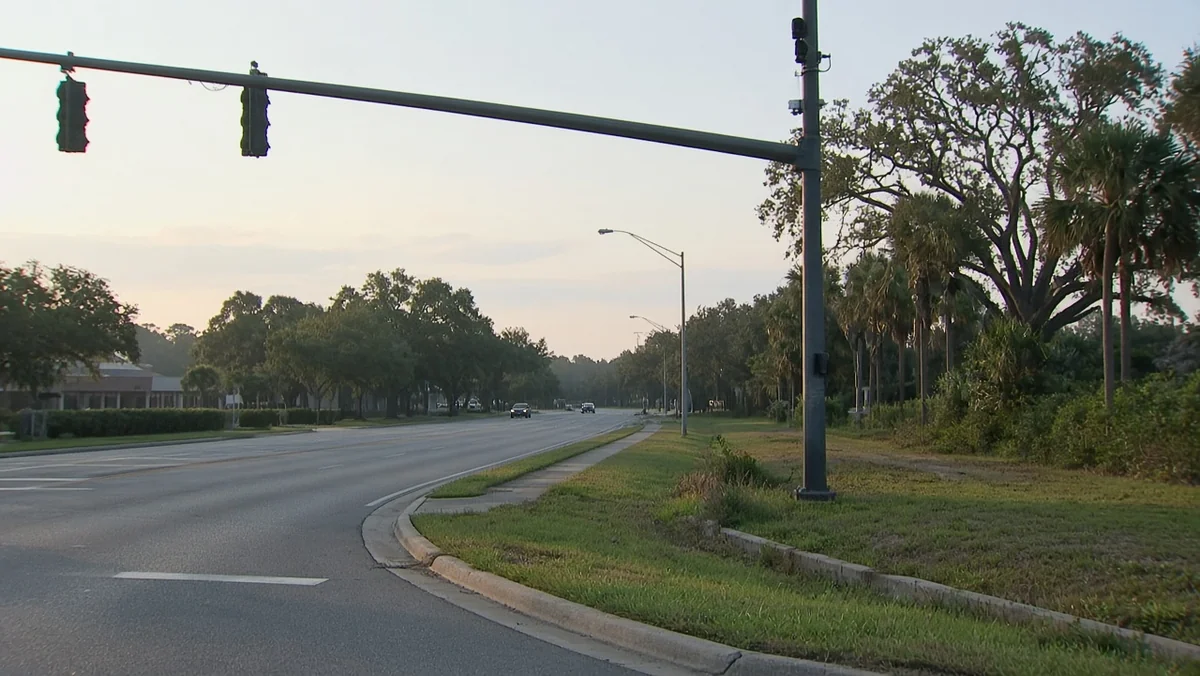
St. Lucie County ALPR cameras are under scrutiny: ST. LUCIE COUNTY, Fla. — St. Lucie County staff have found at least 14 automated license plate reader (ALPR) cameras installed on county rights-of-way without permits and say they still do not know who owns them. The county is posting bright red 30-day removal notices on the devices and bagging the cameras so they cannot operate, interim County Administrator Mayte Santamaria told commissioners, according to CBS12’s Jack Wu on Sept. 16, 2026.
The discovery expands a policy fight that began Sept. 1, when commissioners voted 3-2 to stop issuing permits for Flock and other ALPRs on county-owned or county-controlled property and to remove those devices going beyond a state order limited to Florida Department of Transportation state highways.
How the unpermitted count grew
A county agenda report signed Sept. 10 said field checks had turned up three cameras at unpermitted locations. By the Tuesday night update Wu covered, staff said the count had reached at least 14, and the search was not finished. Staff are still working through the full right-of-way inventory and double-checking some traffic signals that interact with state right-of-way, which could add a handful more. Officials are also comparing crowdsourced location lists against known permitted sites to find unknown installations.
Because there is no permit on file, staff said they cannot identify an applicant to call. That is why notices go on the hardware itself. Santamaria described the approach as posting a bright red notice giving 30 days to remove the device, then bagging cameras so they are not operable.
Authorized devices are being revoked too
The unpermitted cameras sit on top of 52 devices the county previously authorized in its rights-of-way. Staff said all 52 had received revocation notices as of the Monday before the update, also with 30 days to remove them. Permit records indicate most authorized devices were installed on behalf of law enforcement agencies. The county shared its inventory with the St. Lucie County Sheriff’s Office, Fort Pierce Police Department, and Port St. Lucie Police Department before sending notices—both as a courtesy and so agencies could check the data for accuracy.
Staff also told commissioners there were no active applications for new devices under review at the time of the update.
The Sept. 1 vote and privacy concerns
Commissioner James Clasby made the Sept. 1 motion, framing it as a privacy and data-control issue. Clasby, Lee, and Lowry voted yes; Chair Jamie Fowler and Commissioner Cathy Townsend voted no. Clasby later said the mystery of ownership deepens the problem: without knowing who controls the cameras, residents cannot know who receives plate data. He raised the possibility that non-law-enforcement actors could place cameras and said he is not okay with that, Wu reported.
The board’s direction does not apply to license plate readers mounted in law enforcement vehicles or to cameras on private property. That carve-out keeps mobile police ALPRs and private-lot cameras outside this county ROW purge.
Local debates over who controls public space—and what rules apply when technology outruns permits—echo other civic fights Never Late News has tracked, from Charlottes I-77 South express lanes support debate to school-transportation policy reviews in Alexandria’s ACPS bus walk-zone process.
Why this matters
ALPRs collect location-linked plate data at scale. When devices appear on county ROW without permits, residents lose the usual paper trail that shows who applied, who owns the feed, and what retention rules apply. Bagging cameras and posting 30-day notices is a concrete enforcement step, not just a policy statement.
The 3-2 Sept. 1 vote also shows a local government choosing a stricter countywide approach than a state-highway-only order. That matters for Florida drivers who cross city, county, and FDOT boundaries in a single commute and for other counties watching whether privacy-first ALPR limits spread.
Housing and land-use boards face similar “who decides, and on what record?” questions, whether the topic is Costa Mesa’s Fairview housing framework or Seattles transit measure renewal campaign. Surveillance hardware on public ROW simply raises the stakes on transparency.
How Never Late News reported this
Never Late News based this account primarily on CBS12 reporting by Jack Wu (Sept. 16, 2026), including the at-least-14 unpermitted count, bagging and red-notice process, Santamaria and Clasby remarks, the 52 authorized devices under revocation, the Sept. 1 3-2 vote lineup, and the carve-outs for law-enforcement vehicle and private-property ALPRs. Primary source: CBS12’s St. Lucie County unpermitted license plate reader report.